Mazda Advances Development of Onboard CO₂ Capture System
Petit-Lancy, 08.06.2026
- Successfully demonstrates CO₂ storage in Super Taikyu Series testing, supporting the potential to reduce net CO₂ emissions
The Mazda Motor Corporation (Mazda) has conducted a demonstration test of its under-development onboard CO₂ (carbon dioxide) capture system, ‘Mazda Mobile Carbon Capture,’ during Round 3* of the Super Taikyu Series 2026, held from June 5 to 7, 2026. During the test, Mazda demonstrated CO₂ capture and storage during driving —an element newly introduced in this round—representing a further step towards the system’s practical application and supporting its potential to contribute to reducing net CO₂ emissions.
Under the theme “The Joy of Driving Fuels a Sustainable Tomorrow,” Mazda unveiled “Mazda Mobile Carbon Capture” at last year’s Japan Mobility Show 2025, with the aim of supporting efforts to reduce net CO₂ emissions by 2035.
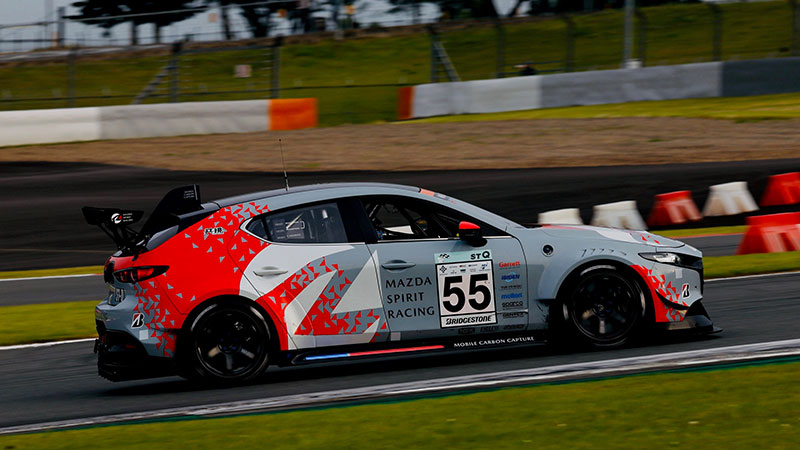
In this demonstration test, a CO₂ desorption function was added to the adsorption unit, along with a CO₂ storage tank, in the race car “MAZDA SPIRIT RACING 3 Future concept” (No. 55), which was powered by hydrotreated vegetable oil (HVO), a fuel that can offer lower lifecycle CO₂ emissions than conventional fossil fuels, depending on feedstock and production pathway. HVO is already in use in Europe.
As in the previous test, zeolite with a porous structure was used as the adsorbent. Zeolite readily releases CO₂ when heated, enabling the captured CO₂ to be desorbed using the exhaust heat generated during driving. The desorbed CO₂ is then compressed by an electric compressor and stored in a tank. Mazda has, for the first time, successfully demonstrated this integrated process as a complete system. Over the course of the 24-hour race, a total of 804 grams of CO₂ was captured, representing a significant advancement—approximately 9.6 times the previous result of 84 grams.
|
Demonstration test comparison |
Previous: 1st test |
Current: 2nd test |
|
Equipment (Function) |
CO₂ adsorption unit (adsorption only) |
Dehumidifier, CO₂ adsorption unit (adsorption and desorption); CO₂ storage tank |
|
CO₂ captured |
84g |
804g |
In addition to the storage experiment, the combined effect of CO₂ reduction achieved through HVO and the amount of CO₂ captured by the system temporarily exceeded the target recovery level assumed for typical use in Mazda production vehicles. The results reflect performance under controlled endurance racing conditions and indicate the potential to contribute to reducing net CO₂ emissions in production vehicles, albeit for a limited period. A full lifecycle carbon balance for the system has not yet been established.
Building on these results, Mazda is entering a new phase of development focused on further testing and refining the system in racing cars, which operate under higher loads and more demanding conditions. Specifically, Mazda aims to further evaluate the potential for reducing net CO₂ emissions in its racing car at Round 7 of the Super Taikyu Series, scheduled for November this year.
Looking ahead, Mazda will continue to collaborate with a wide range of partners to further refine the technology and equipment, with the aim of improving system efficiency, durability, and potential applicability in typical driving scenarios beyond experimental vehicles.
* ENEOS Super Taikyu Series 2026 Empowered by BRIDGESTONE - Round 3: Fuji 24-Hour Race
Related News Releases
- Mazda Begins Demonstration Experiment of Onboard CO₂ Capture System
https://newsroom.mazda.com/en/publicity/release/2025/202511/251117b.html
Related information: Mazda Corporate Website
<MAZDA MIRAI BASE>
- Japan Mobility Show 2025: The Joy of Driving Fuels a Sustainable Tomorrow. Mazda’s Vision for the Future of Smart Mobility in 2035
https://www.mazda.com/en/mazda-mirai-base/articles/20251029-jms2025-concept/ - Japan Mobility Show 2025: The More You Drive, the Cleaner the Planet? The MAZDA VISION X-COUPE and the Future of Joy of Driving
https://www.mazda.com/en/mazda-mirai-base/articles/20251029-jms2025-mazda-vision-xcoupe/ - Creating a Positive Future for Combustion Engine Cars: Mazda’s Public Proof-of-Concept Testing for Carbon Neutral Combustion Engine Car
https://www.mazda.com/en/mazda-mirai-base/articles/20251210-CO2-capture/
<MAZDA SPIRIT RACING>
- Super Taikyu Series: One of Japan’s premier endurance racing series featuring a wide range of vehicle models: (Japanese only)
https://www.mazda.com/ja/experience/mspr/motorsports/supertaikyu/

